
- Company overview The heart of SMC Vision & Philsophy Partnership Certifications Company culture
- Our service Design and Engineering Maintenance and Service Examine Production Line Upgrade and Transformation Storage and Logistics Processing, Trading and Distributor
- Management Our history Global responsibility Info Center
- Procurement center Internship
- Metal Steel Products Stainless Steel Products Aluminum Products Copper Products Galvanized Steel and PPGI Special Alloy Building Material
- Containers ISO Standard Container Equipment Container Storage Container Tank Container Container Fittings Container Trailer Refrigerated/Reefer Container Offshore Container Container House
- Gas Cylinder & Fire Extinguisher Cryogenic Liquid Cylinder Oxygen Gas Cylinder Storage Tank CNG Gas Cylinder LPG Gas Cylinder Hydrogen Gas Cylinder Nitrogen Gas Cylinder Industry Gas Cylinder Fire Extinguisher
- Metal Machinery Motor Forming Machine Cutting Machine Processing Machine Bending Machine Block Machine Spare Parts Other Machinery
- Mechanical Products Conveyor Belt Miscellany Mooring Equipment Laser Equipment Bearing Marine Equipment Vehicle Industry Pressure Vessel
- Electrical System Transformer Production Line Lighting System Power Distribution Automation Electrical Cable Solar Power System Electric Protection System
- Project Plastic Pipes and Pipe Fittings Fiberglass Reinforced Plastic Pontoon System
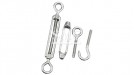
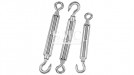
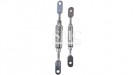
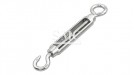
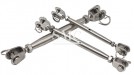
Stainless Steel Turnbuckle


Material: SS 304 / 316 / 310S
Width: 100mm - 2000mm
Wire Diameter: 0.9mm - 4mm
Max Temperature: up to 1100°C
Application: Food processing, glass annealing, heat treatment
Shanghai Metal Corporation is a leading Stainless Steel Turnbuckle manufacturer and supplier.
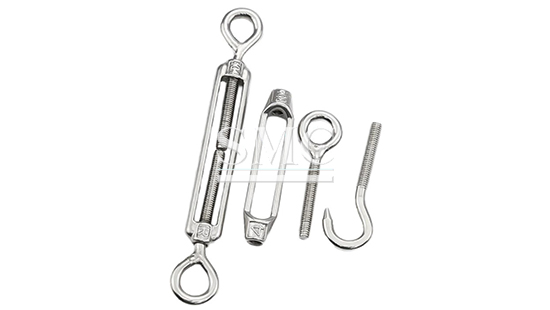
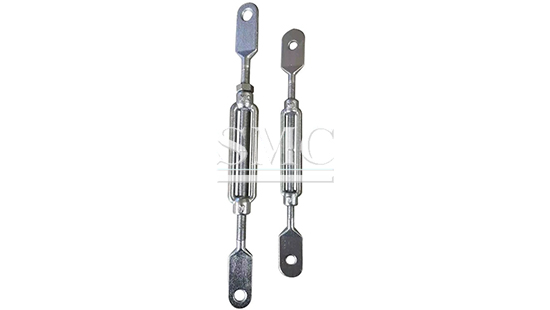
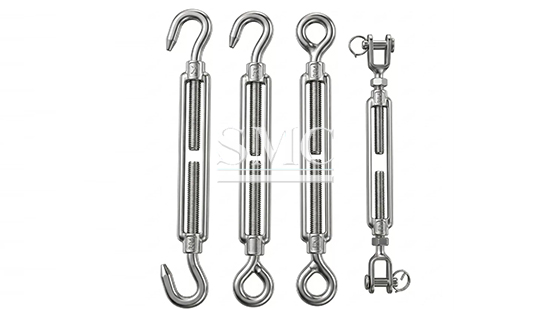
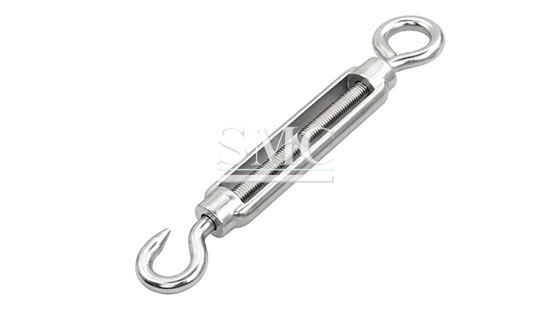
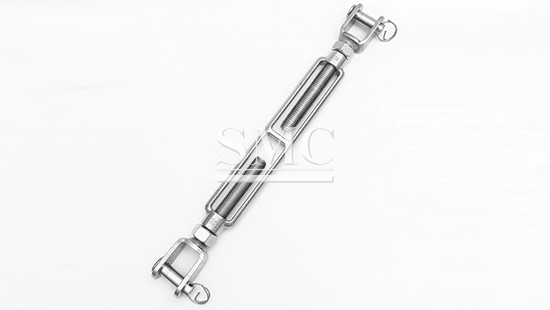
Stainless steel turnbuckle is a threaded tension adjusting hardware fitting. It consists of a central body and two end screws with opposite thread directions. By rotating the central body, users can adjust the overall length to tighten or release cable, wire rope and chain. This hardware solves the problem of inconvenient tension adjustment for cable‑based fixing systems. It avoids frequent cutting and re‑connecting of ropes during installation. Its stainless‑steel construction resists rust and oxidation when exposed to moisture, salt spray and outdoor weather. It keeps stable mechanical performance in long‑term outdoor, coastal and humid working conditions, for securing, bracing and tensioning various structures.
If you want to know more about our stainless steel products or Stainless Steel Turnbuckle price please feel free to contact us, we will reply you within 24 hours.



1. Bidirectional Thread Adjustment
Equipped with left‑hand and right‑hand matched threads, length and tension can be adjusted without detaching connected ropes, saving installation and re‑tuning working time.
2. Corrosion‑Resistant Stainless Steel Material
304/316 stainless steel material reduces rust formation under humid or salt‑spray surroundings, lowering replacement frequency for outdoor facilities.
3. Multiple End Configuration Options
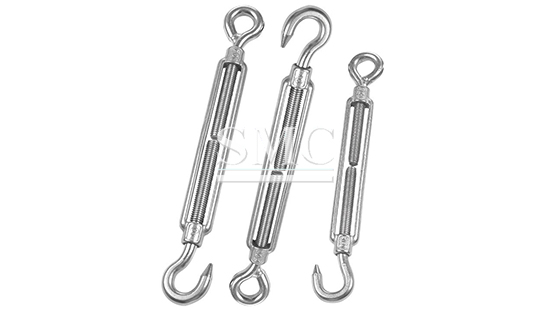
Support hook‑hook, eye‑eye, hook‑eye end combinations, can directly adapt to different connecting hardware without extra adapter parts.
4. Polished Smooth Surface
Smooth polished surface removes burrs on threads and edges, prevents scratch damage to operators and matched wire ropes during assembly.
5. Standard Metric Thread Size
Adopt standard metric thread, compatible with common market fasteners, convenient for spare‑part replacement at customer side.


1. Outdoor Cable Railing Installation
Suitable for balcony and stair cable railing projects. It provides adjustable tension to keep wire rope tight and stable. 316 grade is recommended for seaside buildings to resist salt air corrosion.
2. Tent & Awning Tension Support
Used for large outdoor tents and sun‑awning fixing. It fine‑tunes rope tension to keep fabric flat and reduce sagging under wind load. Open‑body type is preferred for easy routine check.
3. Marine Rigging Tensioning
Applied for small ship rope bracing on deck. 316 stainless steel version fits salt‑water environment to resist seawater corrosion; eye‑eye end style is commonly matched with shackles.
4. Agricultural Greenhouse Bracing
For greenhouse steel wire bracing adjustment. It stabilizes internal support cables against wind force; 304 material is sufficient for inland farm working conditions.
|
Thread Size |
Min. Adjustment Length |
Max. Adjustment Length |
Working Load Limit(WLL) |
Minimum Breaking Load |
Unit Weight |
|
M6 |
80 mm |
140 mm |
0.3 t |
0.9 t |
0.08 kg |
|
M8 |
110 mm |
180 mm |
0.5 t |
1.5 t |
0.15 kg |
|
M10 |
125 mm |
210 mm |
0.8 t |
2.4 t |
0.24 kg |
|
M12 |
150 mm |
250 mm |
1.2 t |
3.6 t |
0.38 kg |
|
M16 |
190 mm |
320 mm |
2.5 t |
7.5 t |
0.72 kg |
|
M20 |
230 mm |
380 mm |
3.5 t |
10.5 t |
1.15 kg |
|
M24 |
270 mm |
450 mm |
5.0 t |
15.0 t |
1.78 kg |
Standard Packaging
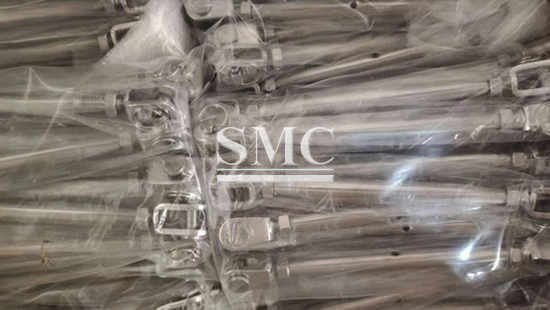
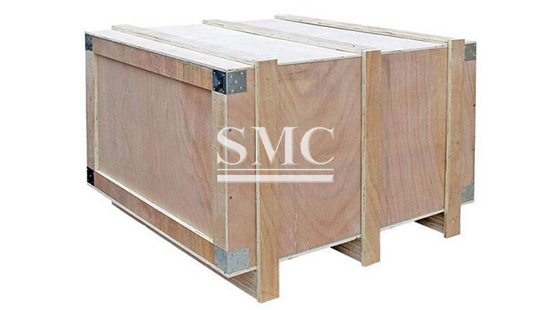
Solid belts coiled with PE film and end caps; wire mesh belts rolled with kraft paper between layers, then PE film. Each roll in reinforced export carton or wooden case
Shipping
We support FCL and LCL sea freight, air freight and express delivery depending on order quantity and destination. Available trade terms include EXW, FOB, and CIF. Other terms may be available upon request. Shipping costs are calculated based on cargo volume, gross weight, destination and selected transportation method.
Leading time
Samples: 3-7 working days
Standard orders: 15-25 working days
Customized orders: 25–40 working days
1. Q: How long does sample preparation take?
A: Sample preparation takes 3–7 working days. For standard SS 304 or 316 wire mesh belts in stock widths, samples can be shipped within 3 working days. Custom weave or solid belt samples require 5–7 working days.
2. Q: What information do you need for a custom quotation?
A: Please provide belt type (solid or wire mesh), material grade, width, length or number of links, wire diameter or strip thickness, edge type, drive method, operating temperature, and quantity. Drawings or photos of the existing belt help us match the specification accurately.
3. Q: What is the MOQ and production lead time?
A: MOQ is 1 roll or 1 piece for standard specifications. Standard orders take 15–25 working days after drawing confirmation. Customized orders take 25–40 working days depending on weave, edge treatment, and quantity.
4. Q: What quality standards does the product meet?
A: Belts are produced under ISO 9001 quality management. Material certificates to EN 10204 3.1 are available. Dimensional inspection and weld quality checks are performed before shipment.
5. Q: What is the difference between solid belt and wire mesh belt for food processing?
A: Solid belt uses flat stainless strip with a closed surface, suitable for sliced products, small parts, and hygienic cleaning where nothing should fall through. Wire mesh belt uses woven or welded wire with open area, suitable for baking, freezing, and drying where air, heat, or liquid must pass through the product bed.
6. Q: How do I choose between SS 304, 316, and 310S for my conveyor belt?
A: SS 304 is for general food and industrial use up to about 600°C. SS 316 is for chemical, marine, and washdown environments where chloride corrosion is a concern. SS 310S is for high-temperature furnaces up to 1100°C, such as glass annealing and sintering.
7. Q: What factors should I consider when choosing a wire mesh belt?
A: Consider operating temperature, load per meter, product size and weight, open area required, drive method (sprocket or friction), curve or spiral path, edge type, and cleaning method. These determine weave type, wire diameter, edge treatment, and material grade.



here
for
price